Difference between net price and gross price

It’s probably happened to you: you agree a price and the invoice doesn’t add up, because one of you meant net and the other gross. That confusion costs money.
The difference between gross and net price is the discounts: the gross price is the starting price of a product or service, before discounts and taxes, and the net price is what’s left once discounts are taken off, which in invoicing and accounting is stated without VAT and matches the taxable amount. What the customer actually pays is the invoice total, which adds VAT to the net price (and deducts any withholding tax, where it applies).
Does the net price include VAT? On invoices and in the accounts, no: it is the taxable amount. Be careful: on many English-language invoices, “net” and “gross” simply mean excluding and including VAT, so “gross” there is the total including VAT. If there is any doubt, write “excluding VAT” or “including VAT”.
A quick example with Spanish VAT (21%): if your list price is €300 and you give a 15% discount, the gross price is €300, the net price is €255 and the customer pays €308.55.
Key points
- Gross price: the list price, before discounts and taxes.
- Net price: the gross price minus discounts, excluding VAT. It is the taxable amount and what your business really takes in.
- Invoice total: net price + VAT − withholding tax, if any. For a consumer, the total is the retail price including VAT.
- Watch the labels: on many English-language invoices, “net” means excluding VAT and “gross” means including VAT.
- The VAT you charge isn’t yours: you pay it over to the tax authority.
- A payslip follows the same logic: gross is the figure before social security contributions and income tax, and net is what the employee takes home.
What is the gross price?
In pricing, whatever the business, the gross price means the same thing: it’s the amount you (or the manufacturer, as a recommended price) set for a product or service before any discounts or taxes are applied. It is your list price, the starting point for every invoice or quote.
That amount has to cover your manufacturing or purchase costs and leave the profit you need to meet your business goals. That is why getting it right is one of the decisions that weighs most on your profit and loss account. Further down you’ll see how to calculate it with an example.
The gross price isn’t necessarily what you’ll charge. If you offer a volume discount, run a promotion or cut the price for any other reason, the final sale amount will be lower. That reduced figure is the net price.
What is the net price?
The net price is what you get when you subtract the agreed discounts and reductions from the gross price. On an invoice it is stated without VAT and matches the taxable amount, which is the figure the taxes are calculated on.
From the seller’s point of view, the net price is what the sale really brings in. You charge the customer the VAT you add to the invoice, but it isn’t yours: you pay it over to the tax authority through your periodic VAT returns. Mistaking the total collected for business income is a common error when working out profitability.
That said, the term is also used in other ways. In everyday commercial language, especially among consumers, “net price” sometimes means the final all-in price, the retail price including tax. And in a lot of English-language invoicing, “net” and “gross” simply mean excluding and including VAT. These overlapping meanings are behind many misunderstandings.
Business-to-business quotes are usually given excluding VAT, because the taxes that apply depend on the type of customer, their activity or where they are based. If you run an e-commerce shop selling to consumers, on the other hand, consumer protection rules require you to show the final price including taxes. That way the customer always knows how much the product will cost, apart from any shipping charges.
Net price vs gross price: the difference
The difference between gross and net price is the discounts: gross is the price before reductions and net is the price after them. Neither includes VAT. If there is no discount, the two are the same. What the customer pays, the invoice total, is a third amount calculated from the net price; for a consumer, it is the retail price including VAT.
| Gross price | Net price | Invoice total | |
|---|---|---|---|
| What it is | List price set by the seller | Price after discounts | What the customer pays |
| Discounts | Not applied | Applied | Applied |
| VAT | Not included | Not included | Included |
| Withholding tax | No | No | Deducted, if applicable |
| On the invoice | Line amounts before discounts | Taxable amount | Total payable |
| Example (€300 and a 15% discount, Spanish VAT at 21%) | €300.00 | €255.00 | €308.55 |
On many UK invoices, “gross” is used for the total including VAT; in this table it means the list price before discounts.
Which one matters more depends on which side of the deal you are on. The seller cares about the net price, because that is what comes in; the private buyer cares about the total, because that is what leaves their pocket. A business buying from another business looks mainly at the taxable amount, since it can normally reclaim the input VAT.
When you send a quote or close a negotiation, make it clear from the start, and preferably in writing, whether the amounts include VAT and whether discounts are already applied. Writing “excluding VAT” or “including VAT” instead of “net” or “gross” avoids disputes, late payments and credit notes.
How do you calculate gross vs net price?
The formulas are simple:
- Net price = gross price − discounts.
- Invoice total = net price + VAT − withholding tax (if applicable).
The hard part isn’t moving from one to the other, but deciding the gross price in the first place. That is where your costs, your margin and what your competitors do come in.
How to calculate the gross price
Calculating the gross price properly underpins the financial results of any business. It is a technical process and every company does it its own way, but there are four building blocks you should always take into account. To go deeper, this guide explains how to calculate the price of a product step by step, with a pricing formula and an example.
- Production or purchase cost: look at the whole process and add up the relevant costs, such as materials, labour or transport to your warehouse.
- Costs after production or purchase: storage, handling, marketing campaigns and any other cost the product carries once it is in your hands.
- Overheads: the company’s fixed costs that you can’t assign to a specific product, such as rent, administration, utilities, advisers or insurance. That total is spread across your products according to forecast sales.
- Profit margin: the percentage you add on top of everything above to make a profit and keep a cushion for the unexpected.
On top of that, every company follows its own pricing policy. Some set a stable price they consider competitive. Others start from a general price list and adjust it as the market moves.
The second approach is very common among online shops selling on channels as competitive as Amazon or Google Shopping. There, the efficient way to work is to define a pricing strategy with clear rules and run it automatically, using price monitoring and dynamic pricing tools.
Either way, the aim is a price that covers your needs and is still competitive. If it isn’t, you’ll struggle to sell, unless yours is a premium brand that customers are willing to pay more for.
Example of calculating the gross price
Say you run an online shop and buy a product directly from the factory. You buy a batch of 1,000 units at €5 each and the supplier charges €100 for shipping. Storing the batch and getting it onto the shelves costs another €600. To cover overheads, simplifying a lot, you add 20%, and as your margin you apply a 40% markup on total cost. The VAT line uses the Spanish standard rate (21%) as an example.
| Item | Calculation | Amount per unit |
|---|---|---|
| Purchase price | €5,000 / 1,000 units | €5.00 |
| Supplier shipping | €100 / 1,000 units | €0.10 |
| Acquisition cost | €5.00 + €0.10 | €5.10 |
| Storage and handling | €600 / 1,000 units | €0.60 |
| Overheads (20%) | (€5.10 + €0.60) × 0.20 | €1.14 |
| Total cost | (€5.10 + €0.60) × 1.20 | €6.84 |
| Margin (40% markup on cost) | €6.84 × 0.40 | €2.74 |
| Gross price | €6.84 × 1.40 | €9.58 |
| VAT (21%, Spain) | €9.58 × 0.21 | €2.01 |
| Retail price including VAT | €9.58 × 1.21 | €11.59 |
Note one detail about the margin. A 40% markup on cost isn’t a 40% margin on price: with €2.74 of profit on €9.58, the real margin is 28.6%. If what you want is a 40% margin on the selling price, the calculation is €6.84 / 0.60 = €11.40. This mix-up between markup and margin is more common than it seems, and we explain it in detail in how to calculate an e-commerce profit margin.
The margin percentage varies a lot depending on your strategy. With a premium pricing strategy it will be high; if you want to win market share by cutting prices to the bone, it will be small. Treat these figures only as a guide: the sound way to set your price is to study your market and your business model.
How to calculate the net price
To get the net price, simply subtract any discounts you have applied from the gross price. If there are none, net equals gross. From there, to know what the customer will pay, add the VAT that applies to that type of product.
Each country sets its own VAT rates within the framework of EU rules, and you can check the current ones in the European Commission’s list of VAT rates in EU countries. Most systems work along the same lines:
- Standard rate: applies to most goods and services (21% in Spain).
- Reduced rates: for certain foods, medicines, books, passenger transport and other items each country chooses. In Spain there are two: 10% and 4%, the latter for essentials such as bread, milk, fruit and vegetables.
- Exempt supplies: carry no VAT, but they aren’t the same as a 0% rate. They typically include education at accredited centres, residential rentals and healthcare.
Other items can change the invoice total, but only in specific cases:
- Withholding tax: some countries require income tax to be withheld on freelancers’ invoices. In Spain, freelancers’ invoices carry a 15% income tax withholding (IRPF) (in Spanish) when they bill companies or other self-employed professionals (lawyers, designers, consultants and so on). An e-commerce business selling products almost never applies it.
- Special retail schemes: some countries have specific VAT schemes for small retailers. In Spain, the equivalence surcharge (recargo de equivalencia) is added to VAT when you sell to retailers taxed under that scheme. It doesn’t affect sales to consumers.
Sales to the Canary Islands, Ceuta or Melilla have their own tax, as these territories are outside the EU VAT area. If you sell there from mainland Spain or the Balearic Islands, the sale goes out without VAT and IGIC or IPSI applies at destination, at its own rates; if your business is based there, you charge IGIC or IPSI instead of VAT.
Sales to consumers in other EU countries also change the calculation. If those sales exceed €10,000 a year, you must charge the VAT of the buyer’s country; you can declare it through the VAT One-Stop Shop (OSS).
Tax rules change and every business has its own circumstances, so the sensible thing is to have a tax adviser or accountant confirm which taxes and rates apply to you. For day-to-day calculations, invoicing software does the maths for you; if you don’t have it, a spreadsheet with the formulas above will do.
Gross and net on an invoice: examples
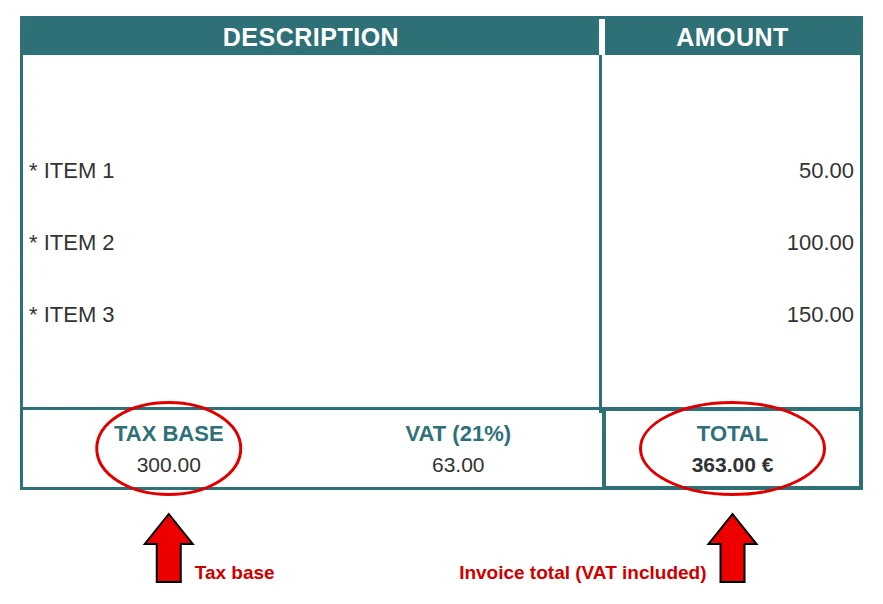
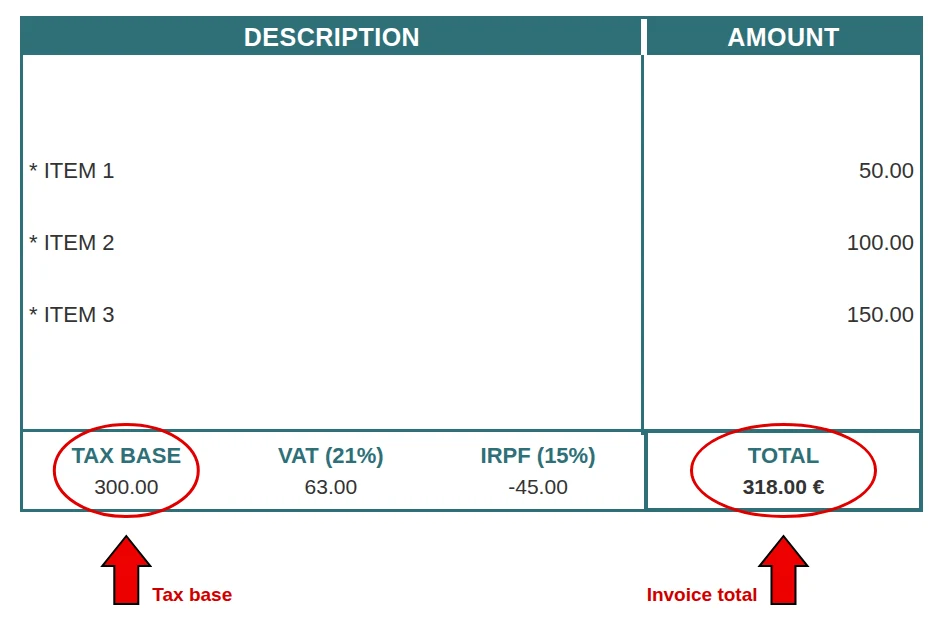
To read gross and net on an invoice, look for two lines: the taxable amount (labelled “Tax base” on the sample invoices), which is the net price excluding VAT, and the invoice total, which is what the customer pays. The two sample invoices below use Spanish rates (21% VAT and, in the second, 15% IRPF withholding) and have no discounts, so the gross price and the net price both match the taxable amount of €300.
Example 1. Invoice with Spanish VAT (21%):
Example 2. Invoice with VAT and Spanish income tax withholding (IRPF):
Here are the figures for both invoices:
| Item | Example 1: with VAT | Example 2: with VAT and IRPF |
|---|---|---|
| Taxable amount (gross and net price, no discounts) | €300.00 | €300.00 |
| VAT (21% of the taxable amount) | +€63.00 | +€63.00 |
| IRPF withholding (15% of the taxable amount) | Not applicable | −€45.00 |
| Invoice total | €363.00 | €318.00 |
The taxable amount is the same in both cases and the total changes. The withholding is calculated on the taxable amount, not on the amount including VAT: €300 × 15% = €45. The person issuing the invoice doesn’t lose that money: the client pays it to the Spanish tax authority as an advance payment on the professional’s income tax.
The taxable amount and the total only match when the invoice carries neither VAT (an exempt or out-of-scope supply, or one under the reverse charge) nor withholding.
Where are discounts applied?
Discounts and reductions are applied to the gross price, before taxes are calculated. That is exactly why the result, the net price, is the base on which VAT and any withholding are worked out.
Using the figures from the examples: if the gross price is €300 and you give a 15% discount, the net price comes to €255 (€300 − €45). VAT at 21% is calculated on that €255, which gives €53.55, and the invoice total is €308.55.
Other uses of gross and net amounts
Gross and net are not only used for prices. The best-known case is salaries, and the logic is the same: gross is the figure before anything is deducted and net is what is left.
A payslip distinguishes between gross salary and net salary, or take-home pay. Gross salary is what the employee earns before deductions, and it is the reference for calculating contributions. Net salary is what they are paid once those deductions are made.
Payslip deductions fall into two groups:
- Social security contributions: the employee’s share, which the employer pays to the social security system together with its own contribution.
- Income tax withheld at source: the employer pays it to the tax authority monthly or quarterly and, in many countries, it is then settled in the annual tax return.
In Spain, for example, employee contributions (in Spanish) come to around 6.5% of the contribution base on a permanent contract, while the IRPF withholding varies with salary and each person’s personal and family situation. That is why the gap between gross and net salary is usually quite a bit wider than many people expect.
How do you keep track of the real margin on each sale?
Keeping track of your real margin means starting from cost, taking off commissions and card fees, and comparing like with like: retail price including VAT against retail price including VAT, or taxable amount against taxable amount. Boardfy is a SaaS platform for competitor price monitoring and dynamic pricing for e-commerce, with direct price updates on Amazon, eBay, Google Shopping and Mirakl marketplaces.
- Boardfy calculates your margin from the product cost, deducting the marketplace commission, card payment fees and any other costs you want to allocate.
- Boardfy never goes below the minimum price or margin you set for each product.
- Boardfy compares competitors’ prices with or without shipping, so you’re comparing equivalent amounts.
Boardfy doesn’t decide your strategy: it applies the rules you define. You can try it with your own catalogue in the 7-day free trial, no card required.