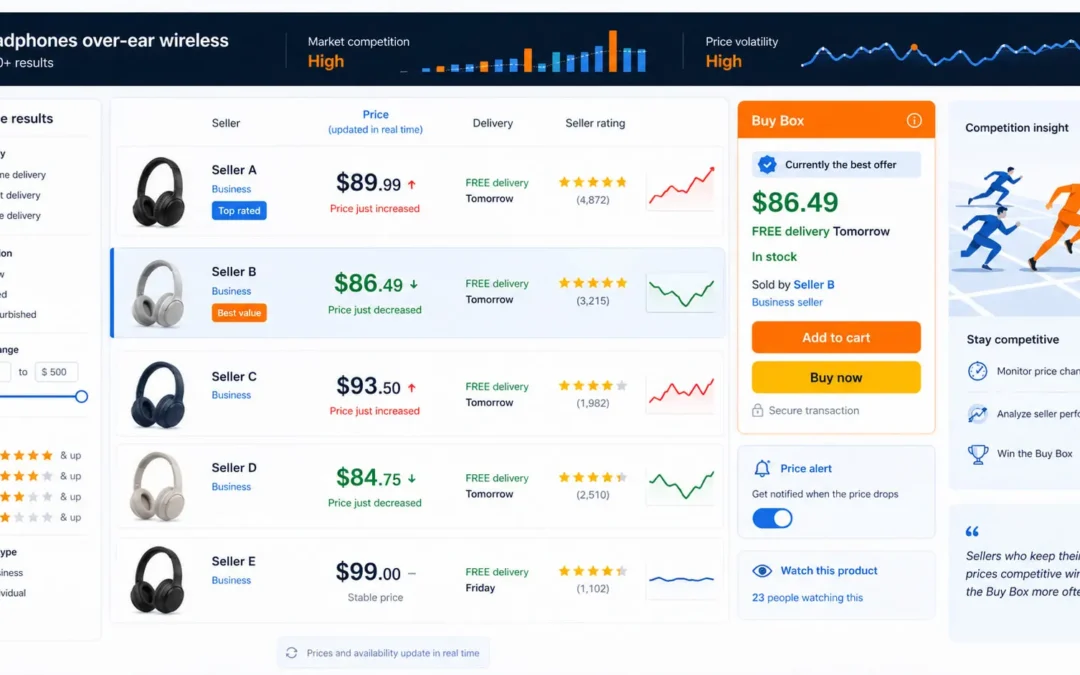
Defining a competitive pricing strategy is one of the biggest challenges for any ecommerce business. Price has a direct impact on conversion rates, brand perception and, of course, profitability. Yet many online stores make pricing decisions reactively, copying competitors or applying discounts without a clear strategic rationale.
A strong competitive pricing strategy is not about always being the cheapest option. It is about choosing the right model based on market context, relying on data, and maintaining control over margins over time. In this article, we explore the main competitive pricing models, when to use them and how to combine them intelligently.
What it really means to have a competitive pricing strategy
An ecommerce business is competitive when it offers a price aligned with the perceived value of the product and with market expectations, while maintaining sustainable profitability.
This requires understanding:
- What competitors are doing and why.
- What margin the business can afford on each product or category.
- How factors such as channel, demand or brand positioning influence pricing decisions.
From there, it becomes possible to build a pricing strategy that is both coherent and adaptable.
Key competitive pricing models in ecommerce
There are several competitive pricing models. Each one responds to different objectives and market contexts, and they are not mutually exclusive.
1. Market-aligned pricing
This model involves keeping prices aligned with the market average. It is common in highly competitive sectors with easily comparable products.
When to apply it:
- Commoditised products.
- Markets with high price sensitivity.
- Large catalogues where stability is a priority.
Example: An electronics ecommerce store that keeps its prices in line with major marketplaces to maintain visibility.
2. Slightly lower pricing to gain market share
Here the goal is to position prices slightly below competitors in order to attract sales volume, without entering unsustainable pricing territory.
When to apply it:
- Launching new products.
- Entering a new market or sales channel.
- Categories where conversion is highly price-driven.
Example: A new brand reducing its price by a small percentage compared to established competitors to gain initial traction.
3. Value-based premium pricing
This model prioritises margin and brand positioning over volume. Prices are higher, but supported by a clear value proposition.
When to apply it:
- Differentiated or exclusive products.
- Brands with a strong reputation.
- Customers who are less price-sensitive.
Example: A gourmet ecommerce business maintaining prices above market average, supported by quality, origin and brand experience.
4. Data-driven dynamic pricing
Dynamic pricing adjusts prices according to variables such as demand, competition, stock levels or broader market conditions. Instead of maintaining a fixed price, it evolves over time.
When to apply it:
- Markets with high price volatility.
- Large catalogues with many competitors.
- Ecommerce businesses looking to continuously optimise both margin and conversion.
Example: A retailer automatically adjusting prices when detecting significant changes in competitor behaviour or demand patterns.
How to combine models for a sustainable strategy
In practice, most ecommerce businesses do not rely on a single model. Instead, they combine several approaches depending on the product, category or sales channel.
For example:
- Best-selling products managed with dynamic pricing.
- Entry-level items priced competitively to attract traffic.
- Premium ranges with more stable, margin-focused pricing.
Not all products play the same role within a catalogue, nor do they compete under the same conditions. The key is to define clear rules and rely on data to decide when to apply each approach, avoiding impulsive or inconsistent pricing decisions.
At this stage, using pricing software for ecommerce makes it possible to implement and scale these strategies in a controlled way. By centralising market data and automating rule-based adjustments, ecommerce managers can adapt prices consistently, protect margins and maintain sustainable competitiveness over time.