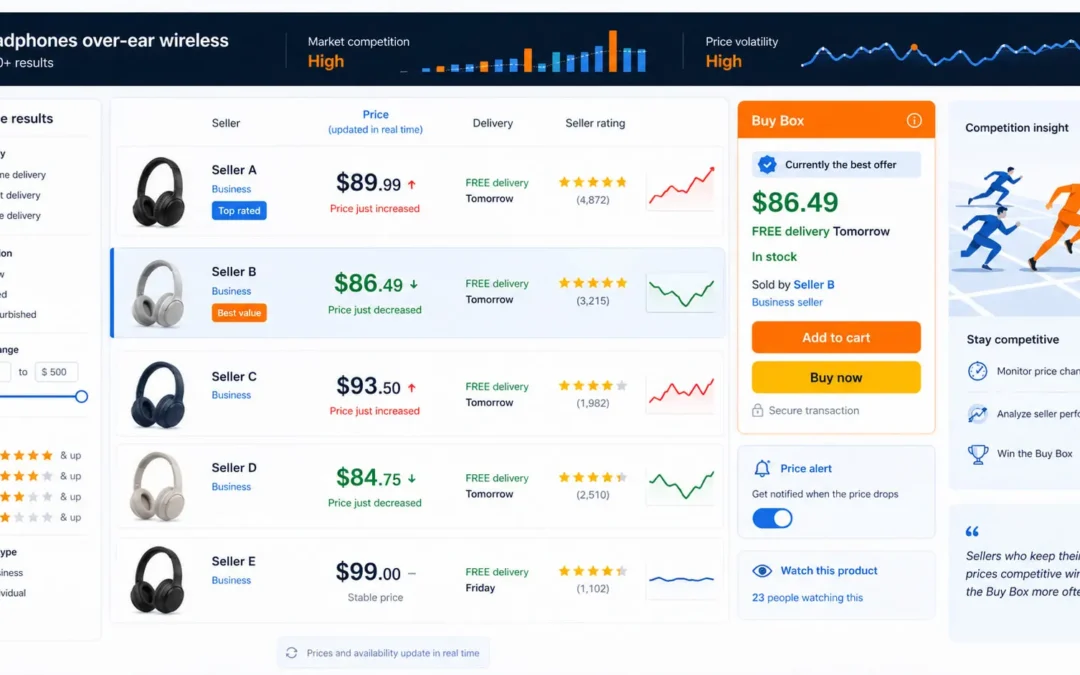
Managing an ecommerce business today often feels like trying to play chess on a rollercoaster. The board keeps moving, the rules keep changing, and just when you think you have the perfect move, a competitor decides to slash the price of your best-selling product at three in the morning.
The most common mistake, and the most dangerous one, is falling into reactive pricing. Checking prices “when you have time”, matching the most aggressive competitor out of fear, or launching discounts blindly just to save the month. The result is always the same: a steady erosion of margins and a frustrating sense of losing control.
This is where price intelligence stops being a technical feature and becomes a strategic lifeline. It is not about watching what others are doing. It is about understanding the market so you can decide when to compete and when to let others lose money.
What does it really mean to compete on price in ecommerce today?
For years, competing in ecommerce has been associated with having the lowest price. However, that approach is becoming less sustainable by the day.
Today, competing on price means:
- Being aligned with the market at all times
- Understanding how your product is positioned against others
- Adjusting prices based on context, not impulse
- Maintaining a balance between conversion and profitability
In marketplaces like Amazon, Idealo or other highly comparable environments, lowering prices without a clear strategy can do more harm than good. True competitiveness is not about being the cheapest option on the list, but about knowing when and how to make better moves than your competitors.
How price intelligence helps you understand the market
Price intelligence is what allows you to take the pulse of your competitive environment. Instead of relying on isolated snapshots, you gain a continuous view of market movements, allowing you to react at the right time.
Through data analysis, you can understand:
- What prices your competitors are applying
- How those prices evolve over time
- Which sellers lead specific categories
- When meaningful changes occur in the market
This transforms your perspective from a one-off observation into a broader understanding. Instead of reacting to what you see in a single moment, you start recognising patterns and behaviours.
The market stops feeling unpredictable and starts becoming interpretable.
The art of finding margin where others only see discounts
One of the biggest myths in ecommerce is that pricing tools are only useful for lowering prices. In reality, the biggest opportunities often come from increasing them.
With structured data, you can identify scenarios that are invisible at first glance:
- Products where competitors are not actively applying pressure
- Moments when you can increase prices without affecting conversion
- Categories where the average market price is higher than yours
- Situations where you are selling below perceived value
Without structured data, these opportunities usually go unnoticed. This is where continuous analysis makes the difference. It not only prevents losses, it also helps improve profitability.
How to apply price intelligence in your ecommerce
For price intelligence to have a real impact, it needs to be embedded into your day-to-day operations.
Some practical ways to apply it include:
- Continuously monitoring your competitors
- Analysing historical pricing data to detect patterns
- Defining clear rules based on business objectives
- Segmenting your catalogue by category, brand or margin level
- Adjusting prices based on market context
Let’s be realistic. No one can keep track of an entire market manually. The volume of data and the speed of ecommerce today would overwhelm any team trying to update prices one by one. Without technological support to automate data collection, accuracy quickly disappears.
Adopting a price intelligence solution for ecommerce gives you back control. It allows you to process all that information at once and turn it into clear actions, making your ecommerce more agile and, most importantly, ensuring that every sale is truly profitable.